Living an Asymmetrical Life: Turning Experience into Story

Write? Right!
Blogging is literature in a hurry. I like writing. I do not like the paperwork. So I built a machine that turns motion into manuscripts, field notes into books, and lived experience into a library.
The Last Chapter Was Never a Place
The sea years gave me horizons. The war years gave me consequence. The pandemic years gave me silence. The publishing years gave me a filing problem.
I have always liked the writing part: the first sentence, the true sentence, the paragraph that finally stops pretending and tells the truth. What I do not like is the paperwork: metadata, categories, ISBNs, descriptions, links, covers, uploads, dashboards, sales pages, and all the little administrative barnacles that attach themselves to a book after the voyage.
Blogging is literature in a hurry. Publishing is literature waiting in line at the DMV. Write? Right!https://m.media-amazon.com/images/I/61qfkQ0tjEL._SL1500_.jpg
From Blog Post to Book
The process is not romantic. The result can be. Tap through the log.
Capture the Spark
A blog post begins as a flare. Something happened. Something mattered. The first job is not to polish it. The first job is to catch it before the paperwork kills it.
Build the Pattern
One post is a moment. Ten posts are a pattern. A hundred posts become an operating system. The writer's job is to notice what keeps returning and give it a spine.
Name the Vessel
Every book needs a hull. Charting Love. Time Millionaire. We Speak English or People Die. A title is not decoration. It is a promise to the reader.
Survive the Paperwork
The upload screen is the reef. Covers, links, descriptions, categories, formats. This is where writers discover that publishing is part art, part logistics, and part customs declaration.
Launch and Keep Moving
A published book is not the end. It is a port call. You wave, take on supplies, fix what broke, and write the next one.
Books From an Asymmetrical Life
Nineteen published books now make up the larger body of work. The shelves below are a curated cross-section; the newest five-book series is mapped separately as one operating system. The sea, the war, the island, the dog, the poker table, the drone age, the time bank. Different shelves. Same engine.
Lives in Motion

Charting Love
A nautical love story about Sarah, Ed, time, motion, and a life measured in horizons instead of possessions.
Open the book
Skyelark MacDoglet: Wisdom on Four Legs
Scottish Terrier wisdom, travel philosophy, cognition, and companionship across borders.
Open the book
Share Fair Isle: The Geography of Bliss
Pandemic solitude on Britain's most remote inhabited island, where weather becomes editor and silence becomes method.
Open the bookAgency & Time

The Authenticity Revolution
A field guide to trading image for impact and choosing presence over performance.
Open the book
Authoring Your Future: Shifting Your Agency
A practical argument for becoming the author of your own future instead of an extra in someone else's script.
Open the book
MAHA-Make America Happy Again
Happiness treated not as a slogan, but as a daily operating decision made at human speed.
Open the book
Overemployment - The Complete Guide To Working Everywhere
Location-independent work, distributed identity, and the art of earning without surrendering your calendar.
Open the book
Who Wants to Be a Time Millionaire?
A philosophy of time wealth: moments over possessions, freedom over accumulation, life over paperwork.
Open the bookDoctrine Under Pressure

Speak English Or People Die - Communication
High-consequence communication for warfighters: language as survival equipment, not classroom decoration.
Open the book
We Speak English Or People Die
From cruise ships to cruise missiles: a teacher at war learns that words can carry the weight of lives.
Open the book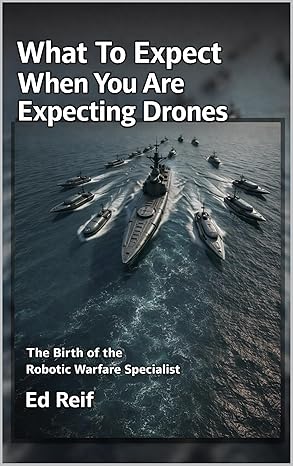
What to Expect When You're Expecting Drones
A practical and philosophical guide to drones, autonomy, judgment, and the human systems that must keep up.
Open the book
Luck Is Probability Taken Personally
Poker, randomness, risk, and the strange human habit of taking variance personally.
Open the book
The Asymmetrical Life
A practical operating system for designing better bets: protect the floor, improve the odds, size exposure, preserve optionality, and leave the upside open.
Open the book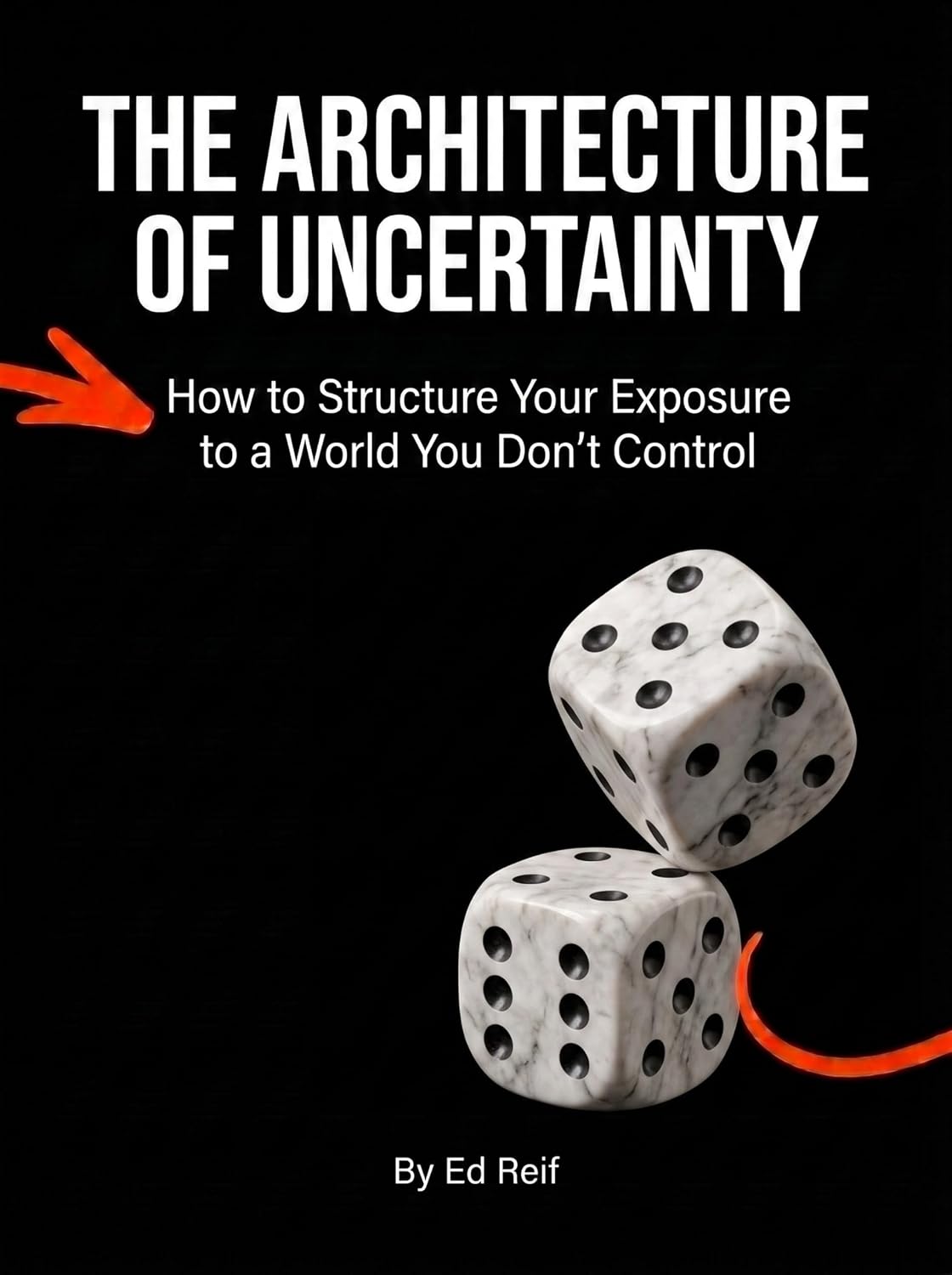
The Architecture of Uncertainty
Agency as engineering: define the control boundary, price what you cannot command, and decide in advance how much uncertainty is allowed to take.
Open the bookThe Asymmetrical Life
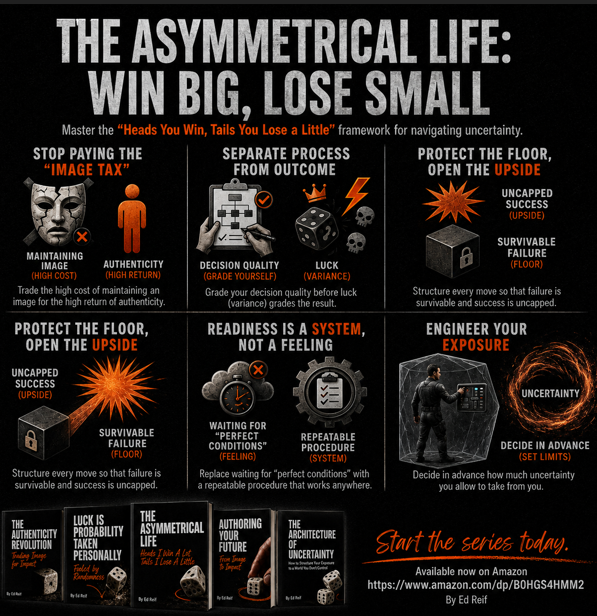
A five-book operating system inside the larger nineteen-book library. The infographic is the doorway; the architecture opens beneath it.
 Featured Series - Five Books
The Asymmetrical Life
Featured Series - Five Books
The Asymmetrical Life
A practical operating system for identity, probability, asymmetric bets, agency, and uncertainty. Open the series to hear the brief, explore the visual grammar, and enter all five books.
A practical operating system for identity, probability, asymmetric bets, agency, and uncertainty. Open the series to hear the brief, explore the visual grammar, and enter all five books.
Five Books. One Architecture.
The Asymmetrical Life is a series about making better decisions when the future refuses to cooperate.
Using poker, decision science, behavioral economics, and real-world experience, Ed Reif explores how to protect the downside, improve the odds, preserve optionality, and stay positioned for outsized upside.
These books are practical operating systems for uncertainty - built to help you think more clearly, risk more intelligently, and create a life where heads you win a lot, and tails you lose a little.
The Brief - By Ed Reif
Win Big and Only Lose a Little
One series. Five positions.
The covers are not separate designs competing for attention. They are one visual system. The black field, restrained typography, recurring object language, and changing state of uncertainty let the reader feel the progression before reading a word.
The infographic maps the complete series as a single body of work: identity, probability, asymmetry, agency, and the architecture of uncertainty.
Maintaining an image is a recurring cost. You pay it in energy, in attention, in the small daily editing of yourself before you enter a room. Nobody sends you the invoice. You just notice, somewhere around the middle of your life, that the balance is gone.
Ed Reif paid that tax for years and thought he was winning. The posts landed. The presentations were flawless. The confidence never cracked. He should have felt successful. He felt like a fraud with good lighting.
What he found on the other side wasn't a healing story. It was an arithmetic problem.
Dropping the performance costs almost nothing. It is the cheapest move available to you - no capital, no credential, no permission required. And the return is uncapped. That is the definition of an asymmetric bet, and most people go their whole lives without noticing it sitting there in front of them.
The Authenticity Revolution is about the three positions that quietly drain the account: emotions you refuse to price, connections you approximate instead of make, and the running commentary in your own head that you'd never accept from anyone else. Each one feels like caution. Each one is leverage working against you.
This is not a book about fixing what's wrong with you. It argues something harder to accept: that the version of you underneath the presentation is not a liability to be managed. It's the only differentiated asset you own.
In these pages:
- Why the trait you've been hiding is usually the one with the highest return
- Defensiveness as a diagnostic instrument - it points at what you haven't dealt with
- Fear and excitement are the same signal in the body; the only difference is what you do next
- The VUE/VIEW framework for connection that doesn't require a script
- Why softening is not a retreat. It's the largest position you'll ever take.
You can keep paying the tax. Most people do, and most of them are competent, admired, and quietly done in by it.
Or you can stop, and find out what the world does with the actual person.
Trade your image for your impact.
Identity and authenticity. Reduce the hidden cost of self-editing before you try to optimize any other bet.

No. It was a perfect decision with a painful outcome. Confusing the two is the most expensive mistake you will ever make - at the poker table, in the boardroom, and in life.
Ed Reif spent twenty years in high-consequence environments where decision quality was measured in outcomes far more serious than chips: teaching aviation English to Afghan Special Forces, designing training systems for autonomous maritime platforms, and sitting at poker tables where the same cognitive architecture that kept your ancestors alive will bankrupt you if left unexamined.
The operating question: can you learn to grade the decision before variance grades the outcome?
Probability and cognition. Build a cleaner mental model of luck, randomness, bias, and process.
Most of us judge decisions by what happened afterward. We call a winning decision smart and a losing decision foolish.
But luck does not grade fairly.
The Asymmetrical Life is Ed Reif's practical operating system for making better decisions when the future remains hidden.
Drawing on poker rooms, career reinvention, travel, publishing, military training environments, a $100 car in Hawaii, Las Vegas, Macau, Hong Kong, and Bangkok, Reif explores a different way to think about risk:
Protect the floor.
Improve the odds.
Size the exposure.
Preserve optionality.
Leave the upside open.
The goal is not to become fearless, certain, or lucky.
It is to become harder to destroy through ordinary error - and better positioned for extraordinary outcomes when they arrive.
Poker is the simulator.
Life is the product.
Strategic architecture. This is the series' core bet-design framework: protect the downside while leaving room for disproportionate upside.
Ed Reif spent twenty years building training systems for people who had to perform anyway - multinational teams in austere locations, requirements that changed mid-week, personnel who rotated out the day before the exercise. The work taught him something that transfers directly to a life: readiness is not a feeling. It's a system, and systems can be built by anyone willing to run them.
Most people wait. For the milestone, the clearance, the moment they finally feel ready. That wait is the single most expensive position you can hold, because the cost compounds quietly and the alternative is almost free. You do not need better circumstances to begin. You need a procedure you'll actually follow at 6 a.m. on a bad Tuesday.
This book gives you one. A personal SOP built on nine principles, with weekly drills that turn pain into data and data into a decision. It's for the high performer stuck in the next-milestone loop, the helper who's overfunctioning for everyone but themselves, and the operator who wants execution that stays calm when the week doesn't.
No permission required. No praise required. No perfect circumstances required.
Agency and execution. Move from waiting for conditions to building a procedure that works inside them.
How to Structure Your Exposure to a World You Don't Control
An interpreter said that at Kabul airport, watching me argue with a schedule that had no interest in me. He was right. The airplane had not taken anything. I had handed it over.
Most advice about uncertainty tells you to think positively, predict better, or accept what you cannot change. This book does something harder. It treats agency as an engineering problem.
Drawing on twenty years in high-consequence environments - war-zone aviation training, FDA-regulated manufacturing, autonomous maritime systems, and several thousand hours at poker tables - Ed Reif builds a working architecture for deciding well when the outcome is not yours to command.
You will learn to draw the boundary between what you control, what you influence, and what you must simply price. To read a probabilistic world without taking variance personally. To choose which games deserve entry, protect the floor beneath which loss becomes ruin, size exposure from evidence rather than excitement, and know when to fold. To recognize the moment pressure stops accelerating your decisions and starts rewriting your rules. And to ask the question risk engineering usually skips: who pays if I am wrong?
The hinge is one sentence. An asymmetrical bet is a reserve clause with a position size attached. The Stoics knew you cannot command the outcome. They never built the structure that decides beforehand how much the outcome may take.
Twenty-five chapters. Six movements. Every one leaves a distinction, a decision rule, a protocol, or a field test - including the Control Boundary Matrix, the Six-Question Decision Audit, the Floor Test, the Exposure Card, the Asymmetry Test, the Downside Map, and the 404 Protocol for the moments when the plan stops loading.
This is not a book about becoming certain. It is a book about becoming capable.
Uncertainty and exposure. The capstone: engineer the boundary, position size, downside map, and reserve clause before reality moves.
Hear the Books Before the Paperwork
Twelve audio dispatches from the larger nineteen-book library. Best with headphones and a window you can stare out of.
- 01 Charting Love Listening Room
- 02 The Authenticity Revolution Listening Room
- 03 Skyelark MacDoglet: Wisdom on Four Legs Listening Room
- 04 Authoring Your Future: Shifting Your Agency Listening Room
- 05 MAHA-Make America Happy Again Listening Room
- 06 Overemployment - The Complete Guide To Working Everywhere Listening Room
- 07 Who Wants to Be a Time Millionaire? Listening Room
- 08 Share Fair Isle: The Geography of Bliss Listening Room
- 09 Speak English Or People Die - Communication Listening Room
- 10 We Speak English Or People Die Listening Room
- 11 What to Expect When You're Expecting Drones Listening Room
- 12 Luck Is Probability Taken Personally Listening Room
The Writer Is the Archive
The publishing years are not separate from the sea years, the war years, or the pandemic years. They are what happens when those chapters refuse to stay quiet. I did not set out to become a warehouse of books. I set out to keep moving and pay attention. The books are the receipts.

Ed Reif
Author, instructional designer, maritime storyteller, war-zone educator, island chronicler, and occasional paperwork avoider. The method is simple: live it, notice it, write it, ship it.
The moments passed. The books stayed. Eventually I understood that publishing was how experience learned to keep moving.
Write the book. Then write the next one.