That's Me In The Corner,Losing My Religion
The Cruising Godfather · Declassified File CG-006
Trials · Vatican CityThat’s Me in the Corner, Losing My Religion
A field report from the epicentre of belief, where the Kodak line was long, the confessionals were empty, and the sacred had already gone digital.
For years, the cover story was simple: I worked on ships. The declassified version is more complicated. I was collecting worlds—and occasionally testing the distance between faith, technology, irony, and a closed confessional.
“The only place where there were no lines were the confessionals.”
The Code Phrase
The Perfect Band Name
Every respectable operation needs a cover band.
I’m thinking of starting a Christian rock band. I’ve got the perfect name—Heretic. You guys know any bass players?
Standing atop Vatican City, the idea of calling a Christian rock band “Heretic” was not blasphemy. It was operational honesty. The great spiritual disruptions began with people the establishment considered dangerous, misguided, or inconvenient.
A fisherman named Peter. A tent-maker named Paul. A carpenter from Nazareth. Every reformation begins when someone is willing to be called a heretic by people who prefer the status quo.

The Declassified Account
Broken Arrow at Saint Peter’s
The epicentre of Roman Catholicism meets the age of the camera phone.

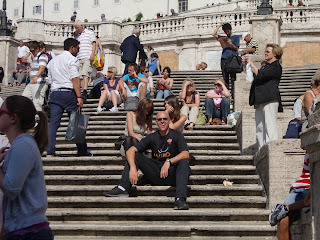
I spent the morning at the epicentre of Roman Catholicism, Saint Peter’s Basilica. People were queuing for Kodak moments. The only place without a line was the confessional.
The contrast was the real sermon. We had become more interested in documenting spiritual experience than having it. The camera was the new confessional booth: we told our stories to the feed instead of to ourselves, a priest, or God.
The sacred had not disappeared. It had changed platforms.
Signal Intercept
CNN Versus the Alphabet
Sin became guilt. Confession became content. Algorithms began listening.
Religion is so pre-September 11th. Twentieth-century psychology replaced sin with guilt.
The fusion of cyberspace and spirituality was a happy accident—a magical realm where the deeply personal became universal. Confessionals became comment sections. Penance became posts. Communion became online community.
Sin implies missing a divine mark. Guilt implies disappointing human expectations. In the new operating system, we did not seek absolution. We sought therapy—and trusted algorithms to interpret the soul.
Machine-God Memorandum
Electric Gaia
The global brain came online, and everybody received a pulpit.
First there was the Pope of Software, Bill Gates. He helped create an electric Gaia—a global brain, a collective unconscious that made what was deeply personal universal: the uncensored, distributed self of cyberspace.
Sartre said, “Hell is other people.” The network replied: we are god—or at least made in his image. The Machine-God whispered through email, platforms, Facebook, YouTube, Twitter, and the endless torrent of digital voices.
“Home isn’t where your heart is. It’s where your computer is. Landlines are place; cellphones are people.”
The Connectivity Gospel
The Dalai Lama of Integration, Steve Jobs, created a celestial jukebox on tap—iTunes absolution for ninety-nine cents. Songs dispensed blessings. Digital communion arrived through shared playlists and viral video.
Operational Failure
The Closed Confessional
Putting the sin back into sincere.
I decided to step into the English-speaking confessional to receive penance. At that exact moment, the Monsignor emerged and hung a sign: CLOSED.
There would not be a second chance to make a first impression. The power of intention, however, seemed sufficient for provisional salvation. As Woody Allen once told me in 1980 at Stromboli’s Pizzeria in Greenwich Village, “Showing up is 99%.”
Voice Inside My Head
Voice: Did you say your prayers today in Rome?
Me: No, but I ate my lunch.
Maybe the closed confessional was itself a kind of absolution—a reminder that intention sometimes matters more than ritual, and that spiritual seeking does not always require institutional validation.
Operational Lesson
I’m a Nobody
You have to become somebody before you can disappear properly.

It was a Zencrafters moment—instant enlightenment in less than an hour. Nobody is perfect, and little me in that enormous church felt like a nobody.
You have to be a somebody first before you can be a nobody. What is sin, after all? It is an old archery term. It means missing the mark. Cut to song: broken arrows and mountains still waiting to be climbed.
The Sistine Chapel was, as we altar boys say, off the chain. Standing beneath Michelangelo’s masterpiece, I felt insignificant and infinite at the same time. The divine and the human were not opposites. They were collaborators.
Putting the odd back into God.
What Remained Hidden
Sometimes enlightenment is not about chasing the light. It is learning to live intelligently with the shadows the light creates.
Closing Transmission
Faith Was Never Lost. It Changed Its Cover Identity.
That was me in the corner—not abandoning belief, but interrogating the machinery around it. The file remains open. The confession may have been closed, but the voyage continued.