Italy’s Timeless Trio: Florence, Pisa & Rome
Four Cities, One Italian Education
Venice taught me that streets can float. Florence made money look like art. Pisa leaned into the joke. Rome turned the skyline into a staircase.
Italy did not feel like one destination. It felt like four operating systems sharing the same appetite.
Venice: Going, Going, Gondola
Venice is a city built on water. A working, living city where everybody gets around in boats. No cars.
It is like walking through a painting, except the painting has traffic. The Earth revolves around the sea here, and the lagoon is not scenery. It is infrastructure.

Walking Through a Painting
The first impression is beauty. The second is how much work it takes to keep beauty alive.

Back in 2014 and Today
Going, going, gondola. The city repeats itself without ever becoming ordinary.
The Working Lagoon
Venice in motion: less postcard, more waterborne operating system.
Florence: Feeding Firenze
Florence was the New York of the Middle Ages: money-centric, ambitious and crowded with proof that wealth occasionally develops taste. The House of Medici were the Godfathers of the Renaissance. Their money became domes, paintings, sculpture and memory.
I visited three churches, which seemed like enough to guarantee heaven. Then I met Michelangelo’s David and discovered that the Renaissance had body-fat goals. The dude is under ten percent, even in marble.
Chianti and veggie lasagna were the appetizers. The rest of the meal was apparently good enough for the wine to erase it from memory.

The Renaissance Engine
Banking, power and patronage turned a compact city into a civilization-sized gallery.

David
Renaissance fitness goals, carved from a single block of marble.

Wine and Wisdom
Sometimes the best travel notes are the memories the Chianti did not erase.
WWMD? What Would Machiavelli Do?
I broke out The Prince and connected with my inner Florentine strategist. Florence does that: beauty in the foreground, power in the footnotes.
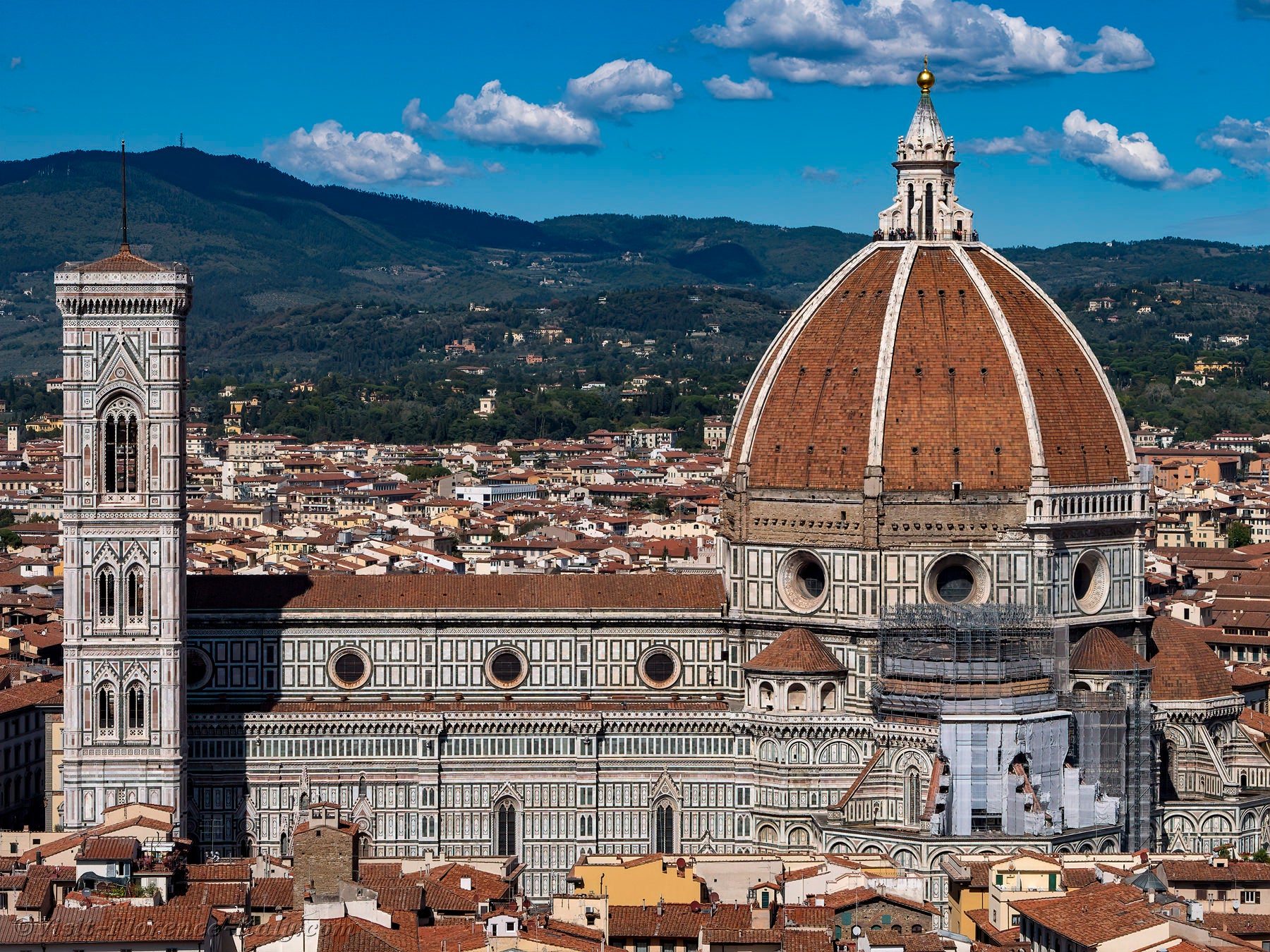
Sacred Engineering
Faith, geometry and civic ambition reaching for the same skyline.

Money Becomes Skyline
The Medici legacy is still visible from above.
Italy in Motion
Florence, sacred architecture and the wider Italian journey.
Pisa: Pizza on Earth
“Pizza on Earth, good will towards Renaissance man.” Pisa is proof that one architectural mistake, properly framed, can become a global personal-brand strategy.
The Leaning Tower is the photograph everyone arrives already knowing. The surprise is the larger composition around it: pale stone, open grass, religious ambition and visitors inventing new ways to hold up a building that has ignored them for centuries.

The Required Pisa Photograph
Discovering the Renaissance spirit in the heart of Tuscany, one lean at a time.
Rome: The View from the Dome
Not many people realize you can take the stairs to the top of the dome at St Peter’s Basilica. That is exactly what I did.
It was the highlight of the trip so far, which was saying a lot because the day before I had been in magical Venice. At the top, Rome stopped behaving like a city and became an argument about scale.
Put this on the bucket list: climb the dome, stand above Vatican City and ring the bells if the opportunity presents itself.

Salt Cure
“The cure for anything is salt: the sea, sweat or tears.”

The Staircase to the Skyline
The dome is not merely something to admire from below. It is a destination.

Bell Ringer
Put ringing the bells in Vatican City on the bucket list.

Epicenter
A morning at the center of Roman Catholicism.

Looking Up
The climb begins with the ceiling making a promise.
Open the 2009 Rome field notes
Broken Arrow
I spent the morning at the epicenter of Roman Catholicism, St Peter’s Basilica. People were queuing for Kodak moments. The only place without a line was the confessionals.
CNN Versus the Alphabet
Twentieth-century psychology replaced sin with guilt. Meanwhile, cyberspace and spirituality were colliding into a happy accident: a magical realm where the deeply personal became universal and location started to lose its authority.
Home was no longer where the heart was. It was where the BlackBerry was. Landlines were place; cellphones were people. Hotel @nyware was becoming a geography of its own.
Welcome to Infinite Smile
Putting the sin back into sincere, I stepped toward the English-speaking confessional. At that exact moment, the Monsignor came out and hung a sign saying closed.
There would not be a second chance to make a first impression. The power of intention would have to provide the salvation. Showing up is 99 percent.
Me: No, but I ate my lunch.
I’m a Nobody
It was a Zencrafters moment: instant enlightenment in less than an hour. Nobody is perfect, and little me in that enormous church felt like a nobody.
You have to be a somebody first before you can be a nobody. Sin, after all, is an old archery term. It means missing the mark.
Mother Mary Comes to Me
Standing in line before the Swiss Guards’ metal detectors, Let It Be played in my headphones while John Lennon’s “Imagine there’s no religion” wandered in uninvited.
Putting the Odd Back into God
I felt much better once I knew God was a white man with a grey beard. The Sistine Chapel was, as we altar boys might say, off the chain.

Rome, 2009
Seven years before the dome climb, the first field notes were already mixing religion, technology and lunch.

A Nobody in a Big Church
Scale has a way of editing the ego.

The Waiting Soundtrack
Let It Be, Swiss Guards and the metal detector before another threshold.
Four Cities, Four Lessons
Venice proved that beauty can be functional. Florence proved that money can become memory. Pisa proved that imperfection can become identity. Rome proved that the best view sometimes requires taking the stairs.
Put them on the bucket list, but do not merely collect them. Let each city revise the operating system.